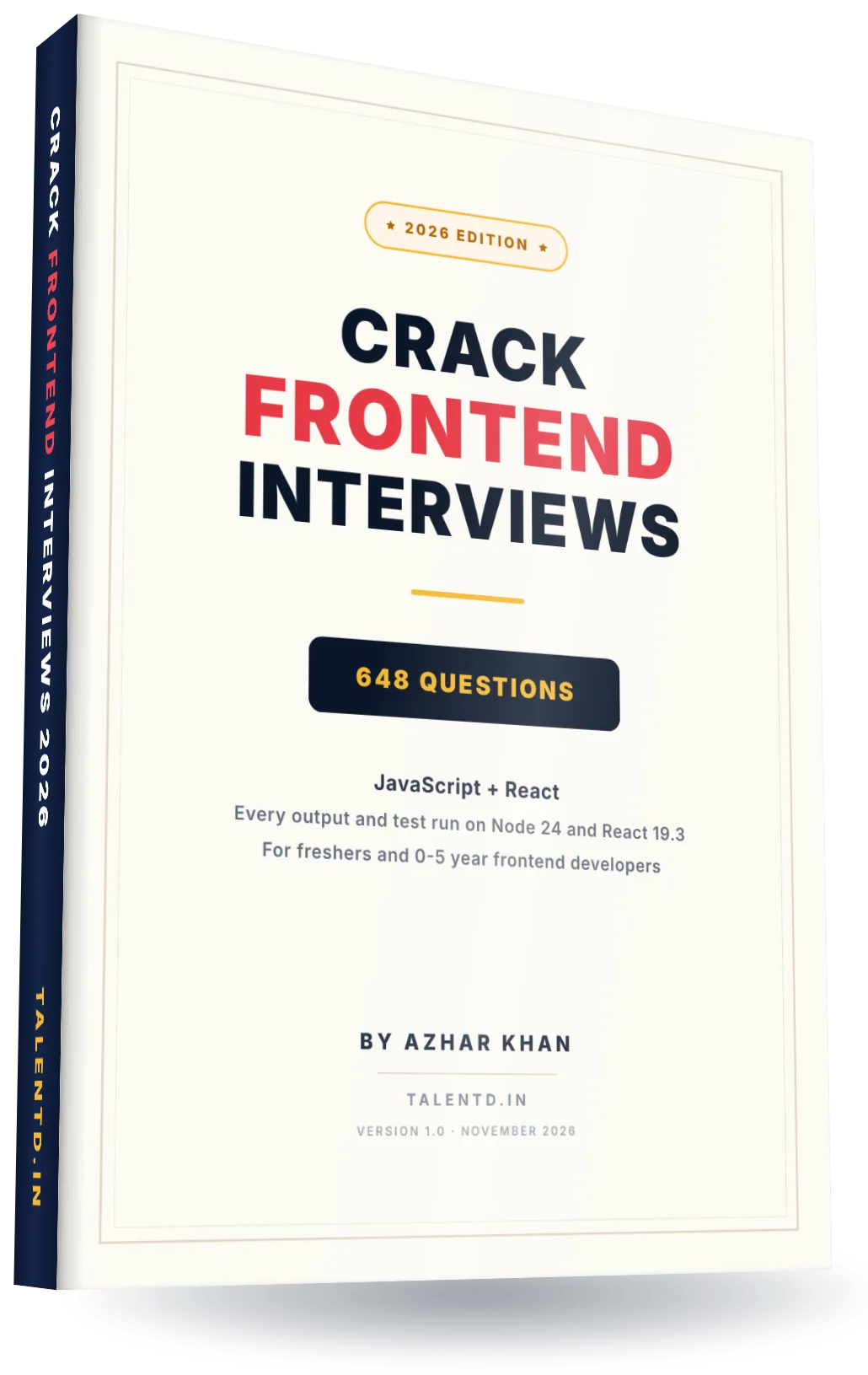
648 interview questions with answers, for freshers and developers with up to 5 years of experience. Every output and every test was run before the book was built.
648 questions: 194 output puzzles, 84 implement-from-scratch answers and 22 machine-coding builds with tests
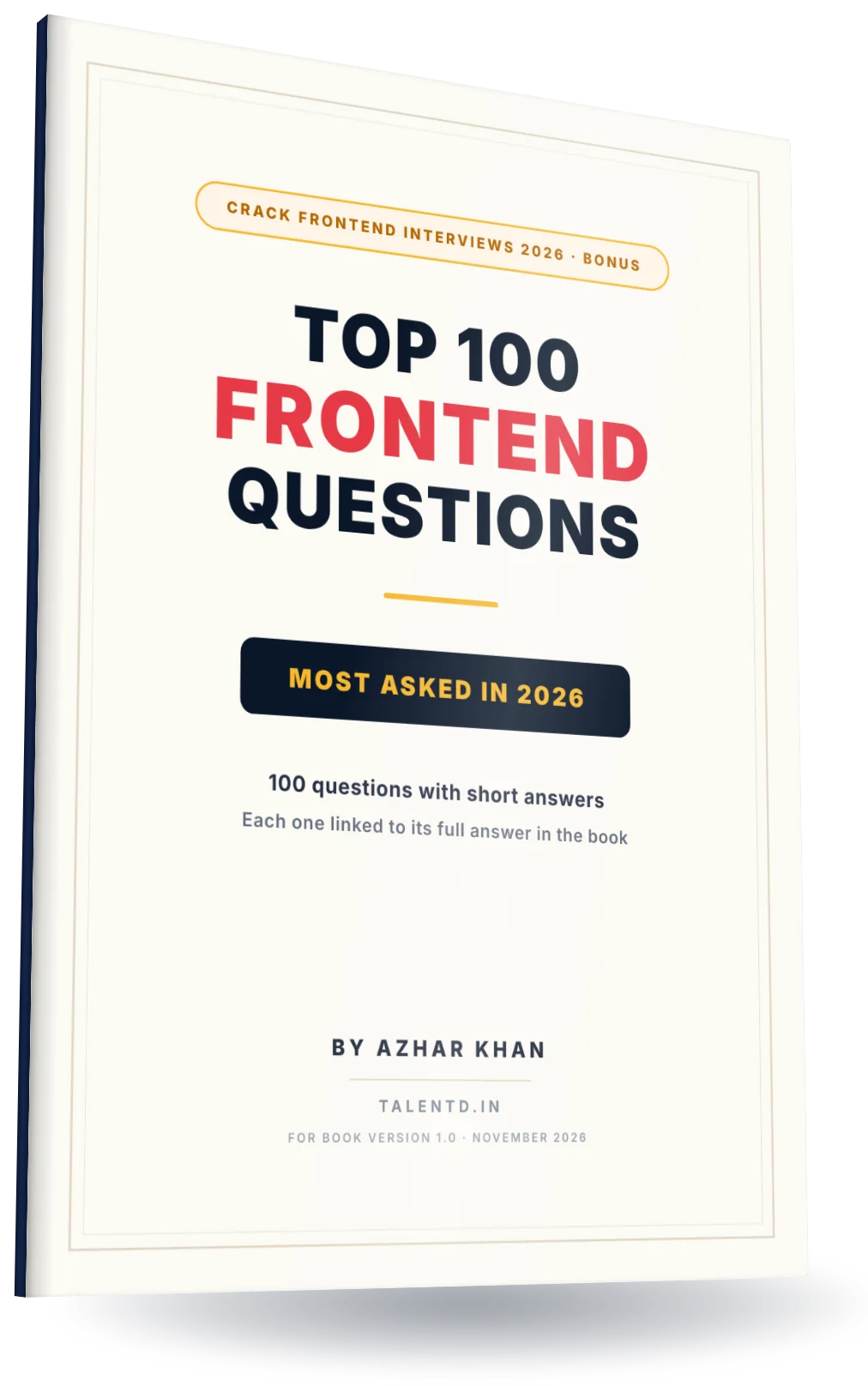
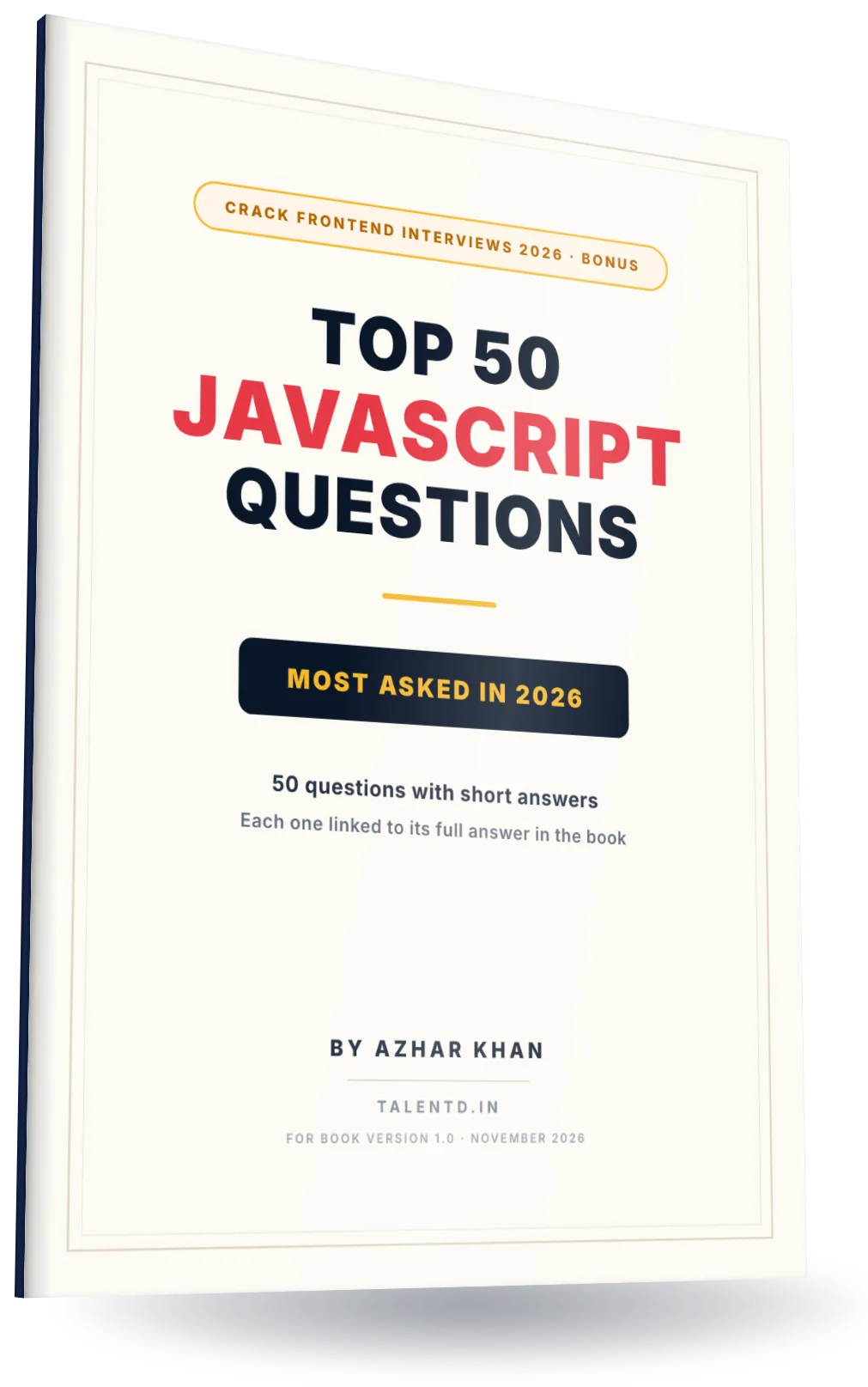
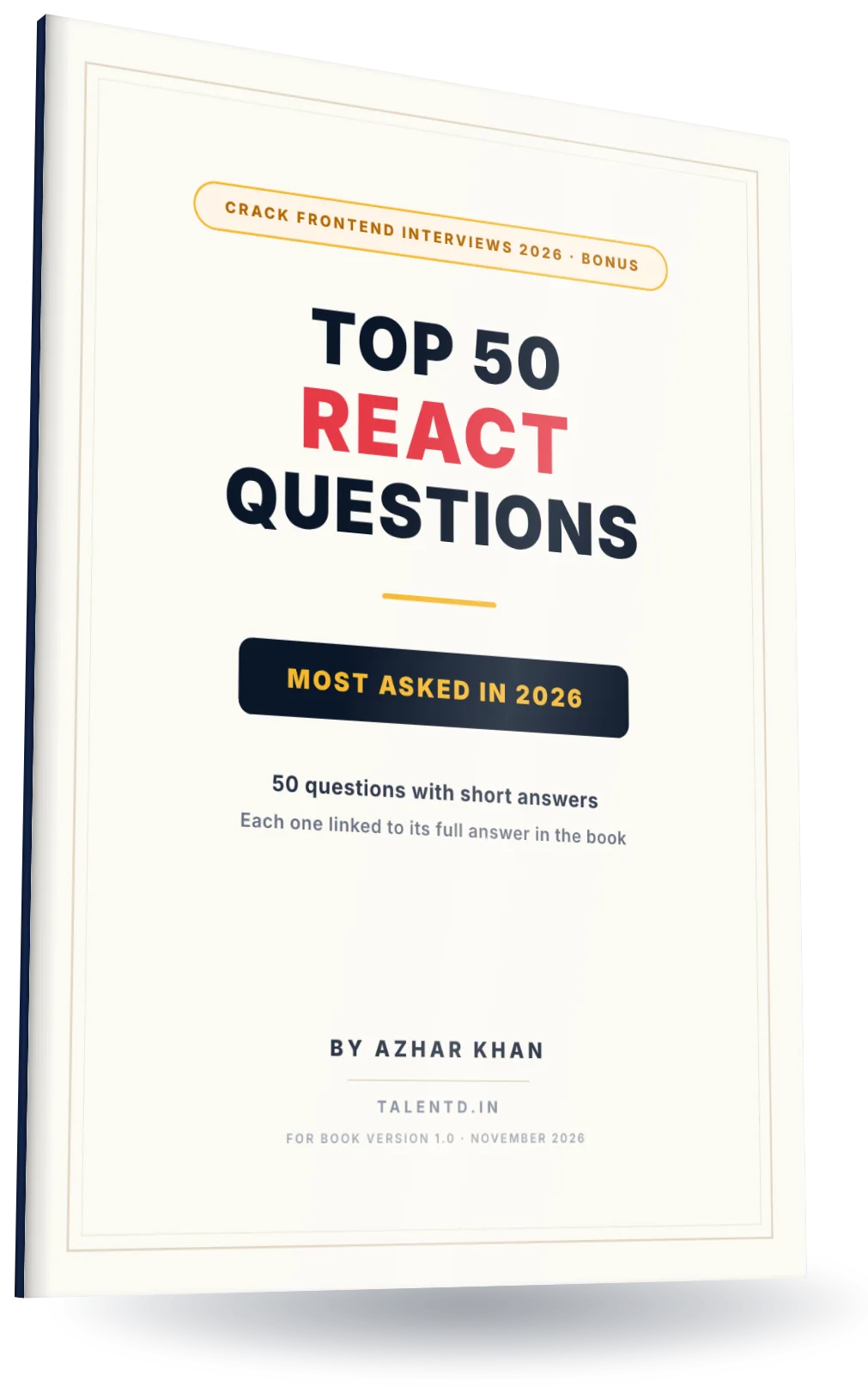
3 bonus PDFs: Top 50 JavaScript, Top 50 React and Top 100 frontend questions
Instant PDF download. Four study plans inside. New versions free from your order page
₹299 for 648 questions is less than ₹1 a question, with the bonuses and the study plans included.
Instant download
30-day refund
Free updates
One-time payment. No subscription. No recurring charge.
Free bonus
Free bonus
648questions
974 A4 pagesRun on Node 24 and React 19.3Tagged from 168 interview reportsRazorpay secure checkout
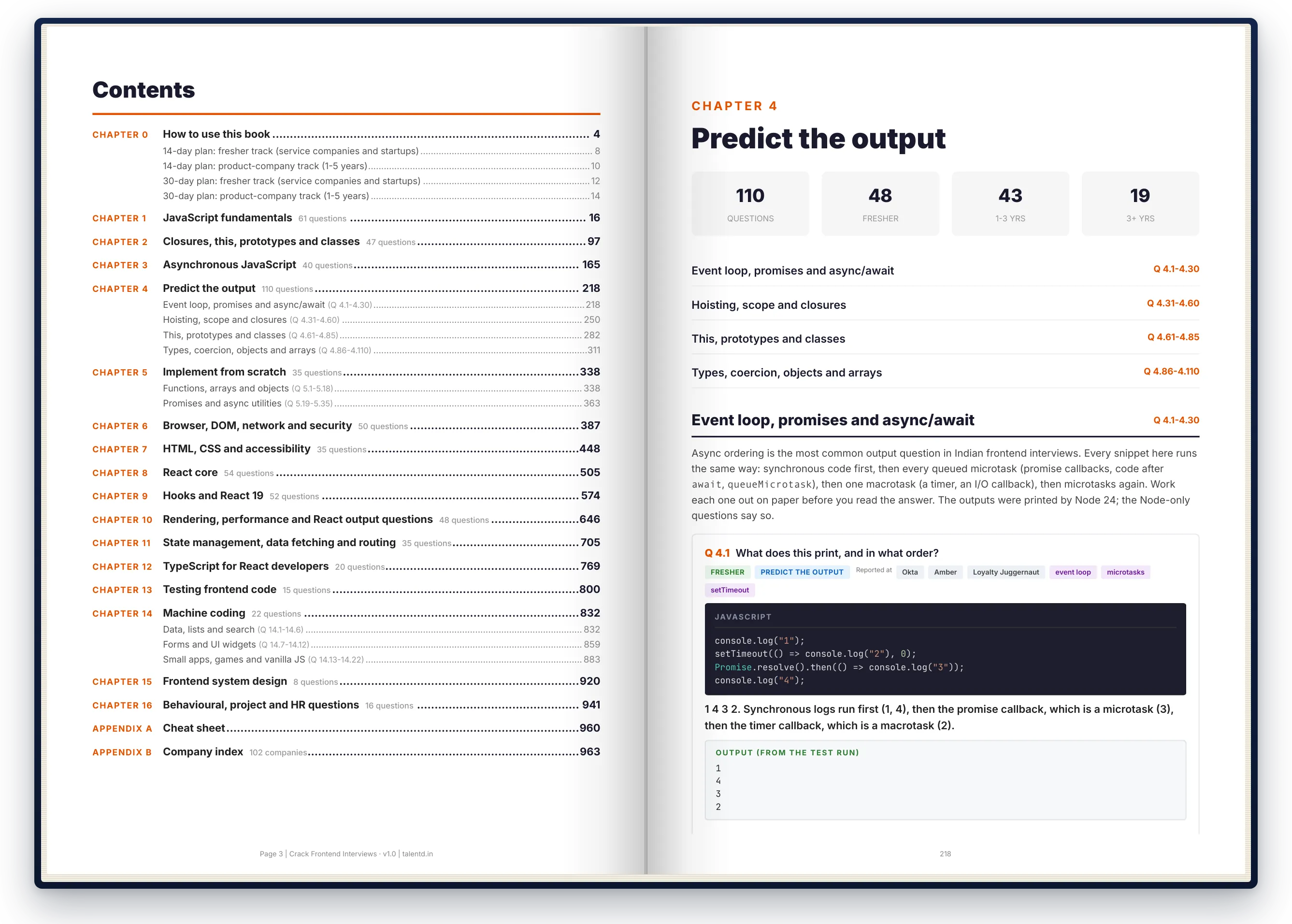
Contents and the Predict the output chapter
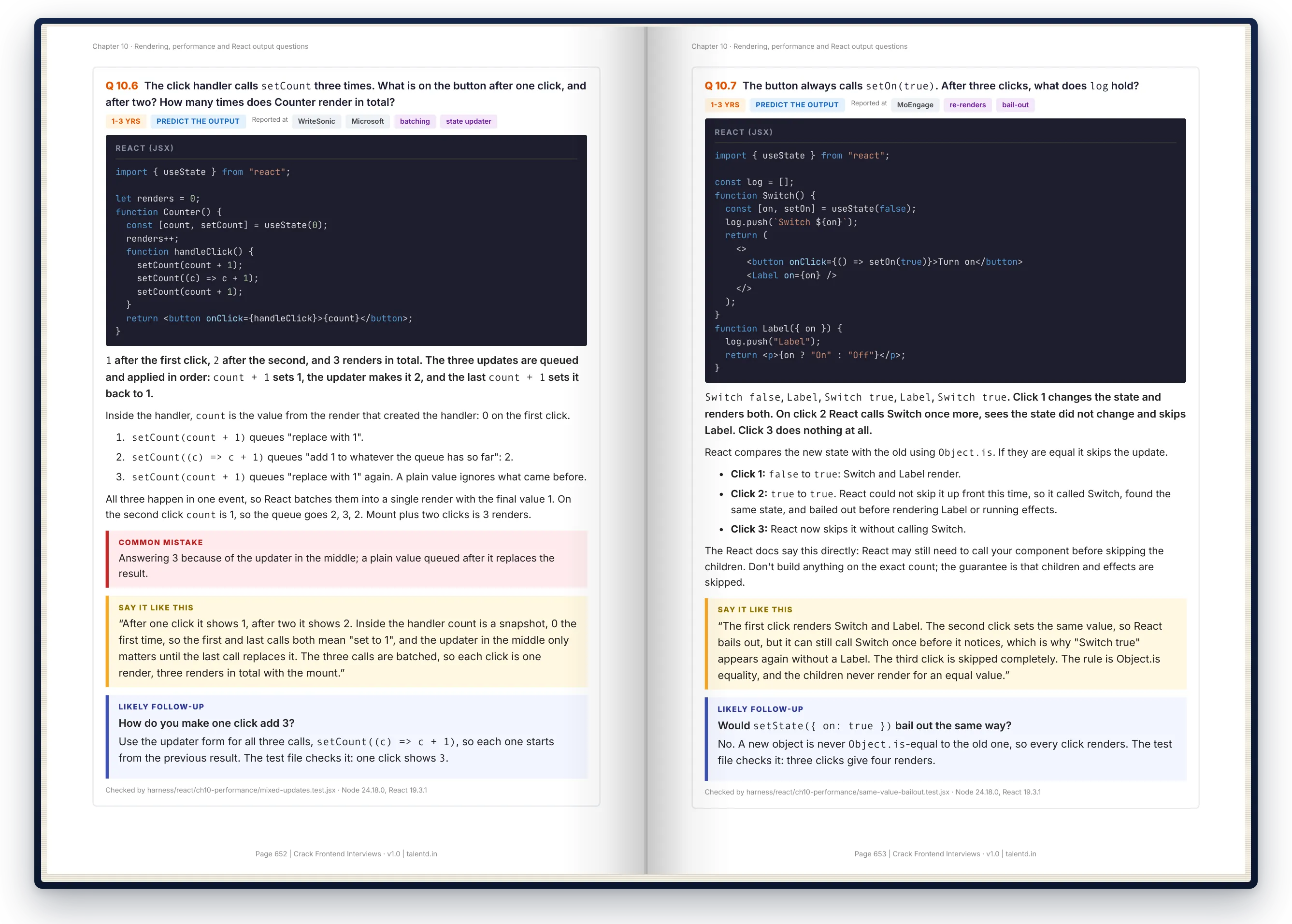
React output questions, checked with Vitest
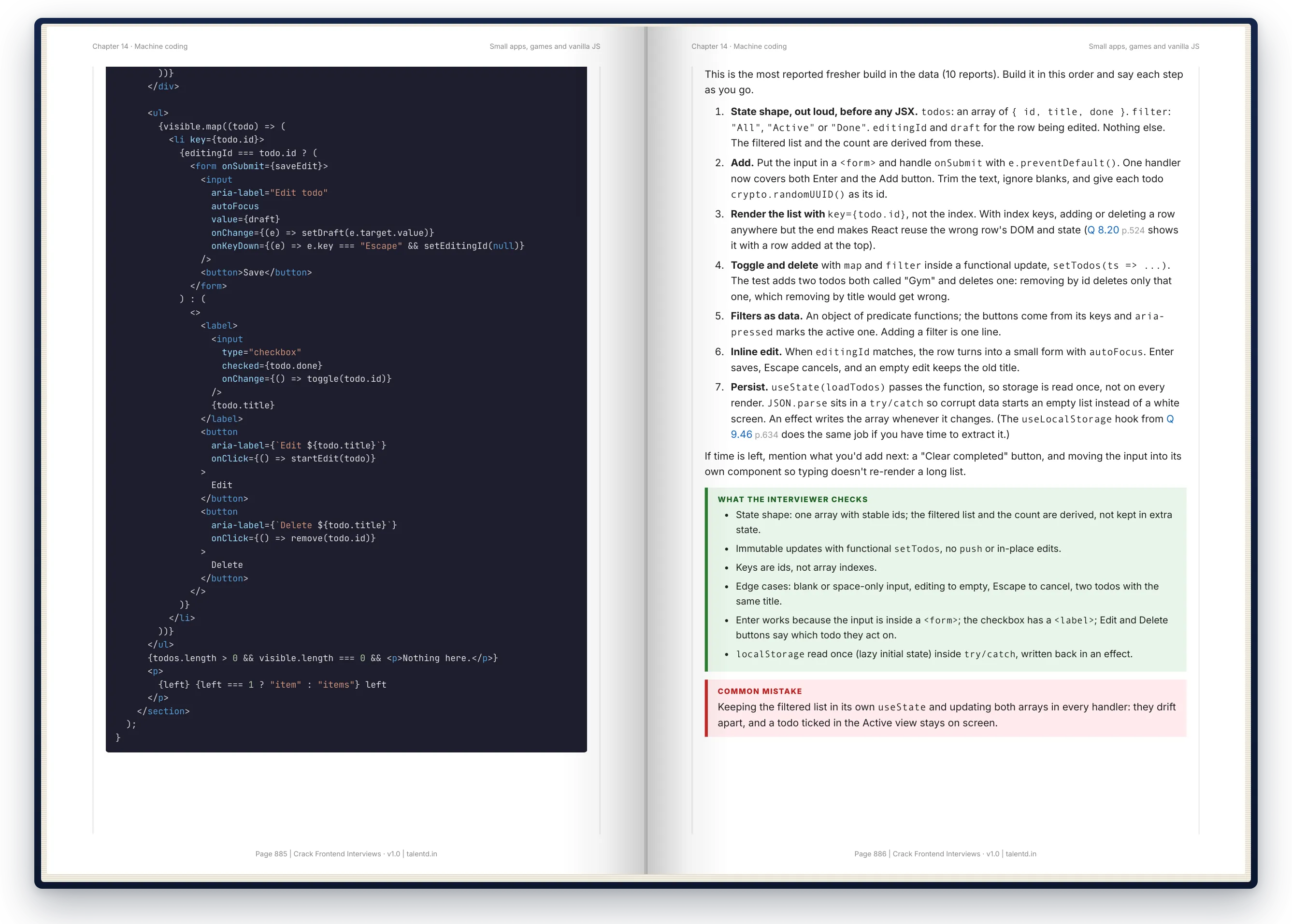
A machine-coding build and what the interviewer checks
Built for
Freshers
Campus drives and your first JavaScript and React round
Service-company developers
Moving to a startup or a product company
1 to 5 year React developers
Internals, performance and the React 19 follow-ups
Product-company rounds
Machine coding, output puzzles and frontend design
/ The real test
You write JavaScript every day. The round still catches you out.
Interviewers paste ten lines of async code and ask what prints. They ask for debounce from a blank file, or a to-do app in 45 minutes while they watch. Then they ask why it rendered three times.
Work rarely asks any of that, so people who ship React every week still freeze on it.
This book puts 648 of those questions in front of you, the outputs run and each follow-up written out.
/ See what's inside
Read 3 real questions from the book
An output puzzle, a React question and an implement question, copied from the book. Open the answer to see the output, the explanation and the follow-up.
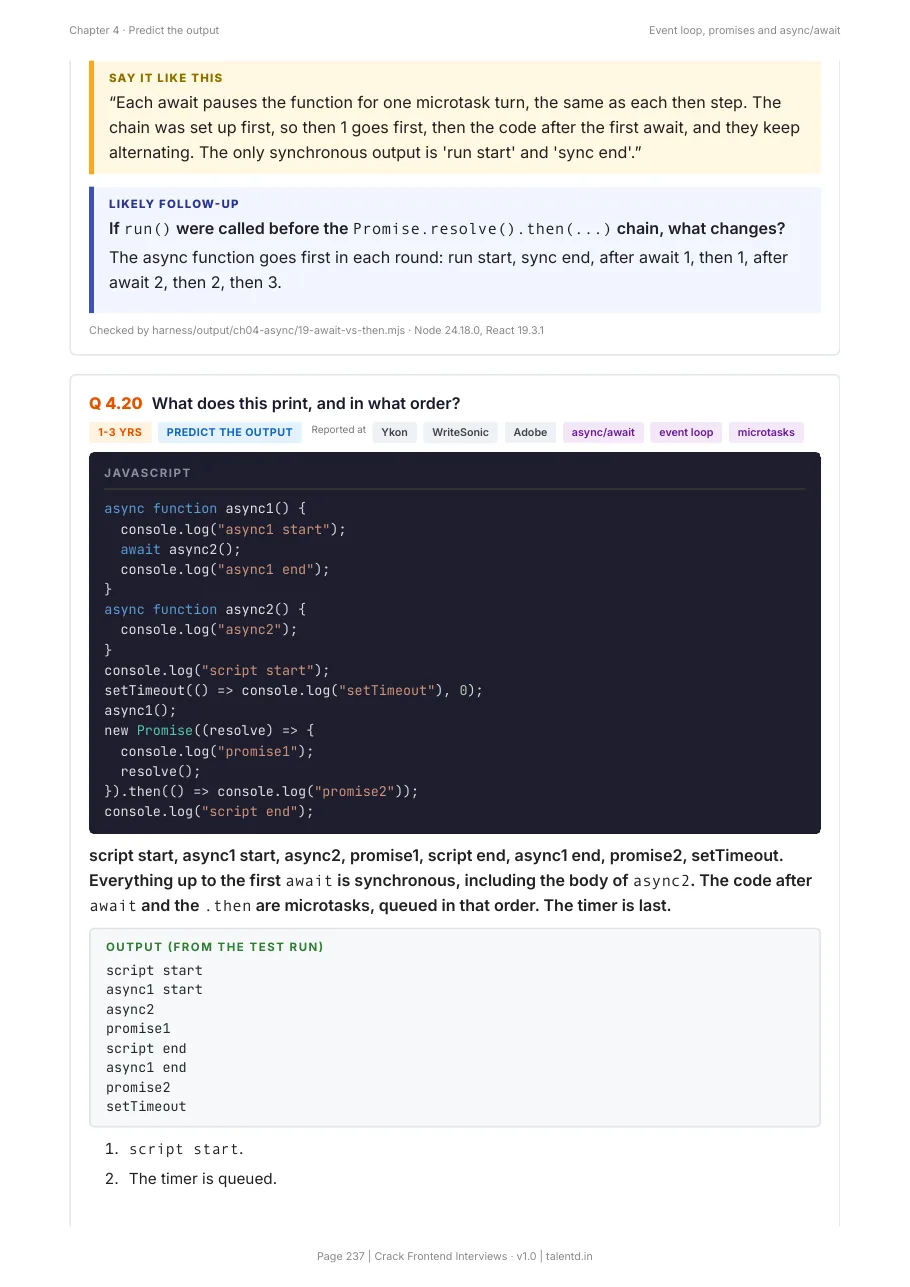
script start
async1 start
async2
promise1
script end
async1 end
promise2
setTimeout
script start, async1 start, async2, promise1, script end, async1 end, promise2, setTimeout. Everything up to the first await is synchronous, including the body of async2. The code after await and the .then are microtasks, queued in that order. The timer is last.
Likely follow-up
What if async2 ends with return Promise.resolve()?async1 end moves back two microtask turns. An async function that returns a promise has to follow it, which costs extra turns. With a longer chain (promise2, promise3, promise4), it would print after promise3.
Checked by harness/output/ch04-async/20-async-calls-async.mjs · Node 24.18.0
Chapter 10 · Q 10.6
1-3 yrs·Batching · state updater
Three setCount calls in one click
The click handler calls setCount three times. What is on the button after one click, and after two? How many times does Counter render in total?
import { useState } from"react";
let renders = 0;
function Counter() {
const [count, setCount] = useState(0);
renders++;
function handleClick() {
setCount(count + 1);
setCount((c) => c + 1);
setCount(count + 1);
}
return <button onClick={handleClick}>{count}</button>;
}
Reported at: WriteSonic, Microsoft
See the answer
1 after the first click, 2 after the second, and 3 renders in total. The three updates are queued and applied in order: count + 1 sets 1, the updater makes it 2, and the last count + 1 sets it back to 1.
Common mistake
Answering 3 because of the updater in the middle; a plain value queued after it replaces the result.
The test file checks
a plain value after an updater replaces it
updaters chain
Likely follow-up
How do you make one click add 3?Use the updater form for all three calls, setCount((c) => c + 1), so each one starts from the previous result. The test file checks it: one click shows 3.
Checked by harness/react/ch10-performance/mixed-updates.test.jsx · Node 24.18.0, React 19.3.1
Chapter 5 · Q 5.1
Fresher·Debounce · closures · timers
Debounce, with leading mode and cancel()
Implement debounce(fn, wait, { leading }) with a cancel() method.
Reported at: Flipkart, Razorpay, Swiggy, Trintech
See the answer
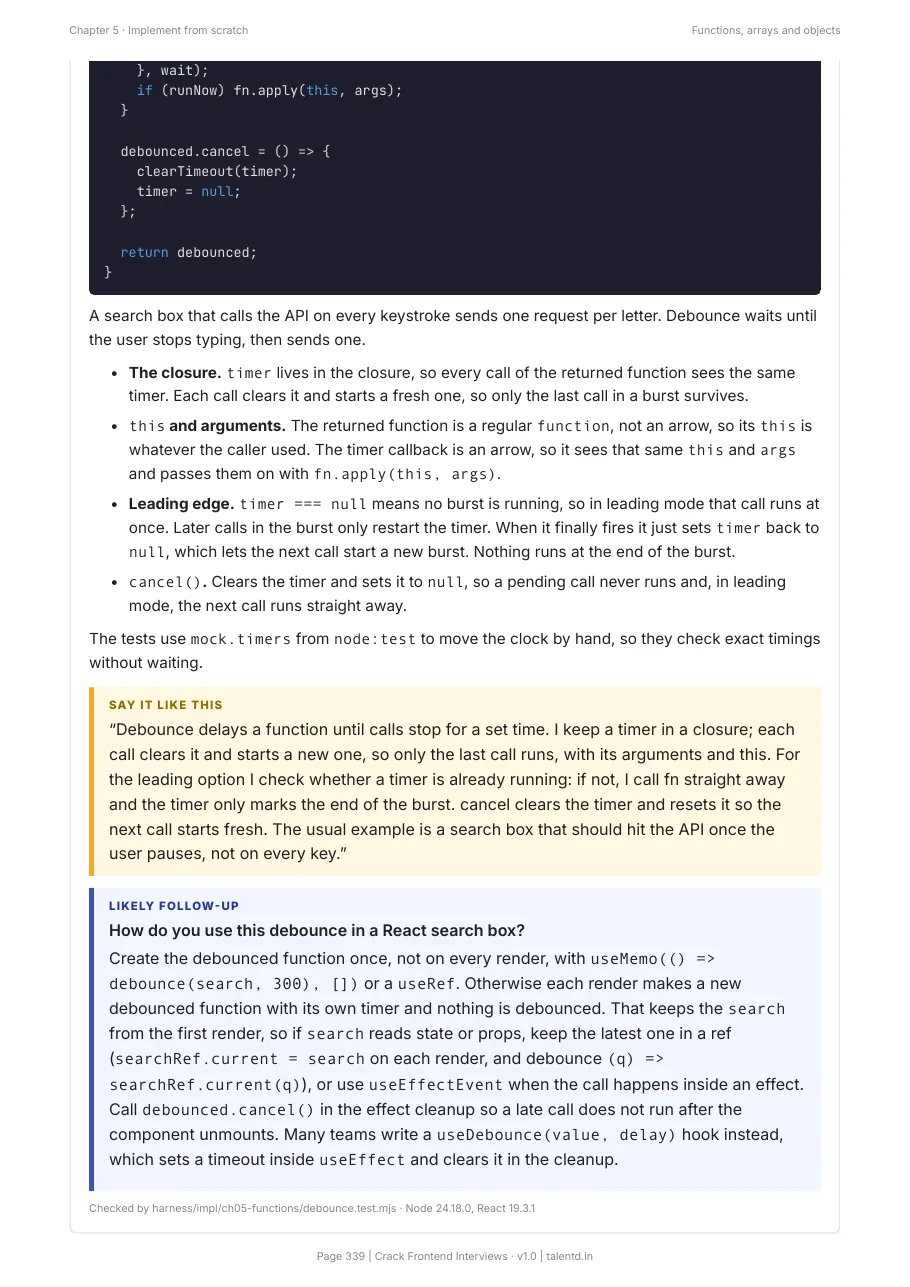
Keep one timer in a closure. Every call clears it and starts a new one, so fn runs only after wait ms with no calls, with the last call's arguments and this. With leading: true, run the first call of a burst at once and use the timer only to tell when the burst ends. cancel() clears the timer.
// Runs fn once calls stop for `wait` ms, with the last call's arguments and `this`.// { leading: true } runs the first call of a burst at once and drops the rest of the burst.// cancel() drops a pending call.exportfunction debounce(fn, wait, { leading = false } = {}) {
let timer = null;
function debounced(...args) {
const runNow = leading && timer === null;
clearTimeout(timer);
timer = setTimeout(() => {
timer = null;
if (!leading) fn.apply(this, args);
}, wait);
if (runNow) fn.apply(this, args);
}
debounced.cancel = () => {
clearTimeout(timer);
timer = null;
};
return debounced;
}
The test file checks
runs once, after calls stop, with the last arguments
keeps this and passes every argument
a new burst after the wait runs again
leading: runs the first call at once and nothing at the end of the burst
leading: calls during the burst keep pushing the quiet period out
cancel() drops the pending call
cancel() resets leading mode so the next call runs at once
Likely follow-up
How do you use this debounce in a React search box?Create the debounced function once, not on every render, with useMemo(() => debounce(search, 300), []) or a useRef. Otherwise each render makes a new debounced function with its own timer and nothing is debounced. That keeps the search from the first render, so if search reads state or props, keep the latest one in a ref (searchRef.current = search on each render, and debounce (q) => searchRef.current(q)), or use useEffectEvent when the call happens inside an effect. Call debounced.cancel() in the effect cleanup so a late call does not run after the component unmounts. Many teams write a useDebounce(value, delay) hook instead, which sets a timeout inside useEffect and clears it in the cleanup.
Checked by harness/impl/ch05-functions/debounce.test.mjs · Node 24.18.0
That's 3 of 648. The rest, with the study plans and three bonus PDFs, are ₹299.
/ The diagnosis
Four reasons good developers still lose the round
Whether you've been rejected before or it's your first interview next week, one of these is usually the gap.
/ 01
Output puzzles need the exact order.
Ten lines of promises, timers and await, and one question: what prints? Knowing roughly how the event loop works gets you a wrong answer said with confidence.
/ 02
Writing it from a blank file is harder.
You have used debounce, Promise.all and bind for years. Writing one on a shared screen, with cancel(), errors and this handled, is a separate skill.
/ 03
The follow-up decides the round.
“Now make one click add 3.” “Why did it render three times?” Most people prepare the first answer and meet the second one live.
/ 04
Machine coding runs on a clock.
In the product-company reports behind this book, nearly two in three had a machine-coding round. A to-do app is easy with a free afternoon. In 45 minutes, with keys and state shape being marked, it's harder.
/ What's inside
648 questions in 16 chapters
JavaScript first, then React, then the rounds that aren't question and answer at all.
293
JavaScript
Chapters 1 to 5: the questions every frontend round opens with.
JavaScript fundamentals61
Closures, this, prototypes and classes47
Asynchronous JavaScript40
Predict the output (event loop, scope, this, types)110
Implement from scratch (polyfills, async utilities)35
189
React
Chapters 8 to 11, written for React 19, with useEffectEvent and Activity from 19.2.
React core54
Hooks and React 1952
Rendering, performance and React output questions48
State management, data fetching and routing35
166
Everything around them
The browser, CSS, TypeScript, testing, and the build and design rounds.
Browser, DOM, network and security50
HTML, CSS and accessibility35
TypeScript for React developers20
Testing frontend code15
Machine coding (22 builds)22
Frontend system design8
Behavioural, project and HR16
/ Every question includes
More than the answer. The whole breakdown.
1The short answer
What you must get across in the first 20 seconds
2The real output
For output questions, the exact text the snippet printed when it was run
3The explanation
Why the answer is what it is, step by step
4The common mistake
Where there is one: the wrong answer most candidates give
5Say it like this
The answer as you would say it out loud, in three to five sentences
6The likely follow-up
The next question the interviewer asks, with its answer
/ See it before you buy
Real pages. Real code. Real output.
Pages from the book as you'll get them, in a PDF with clickable contents and question links.
Q 4.20 with the output from the test run
Debounce: code, spoken answer, follow-up
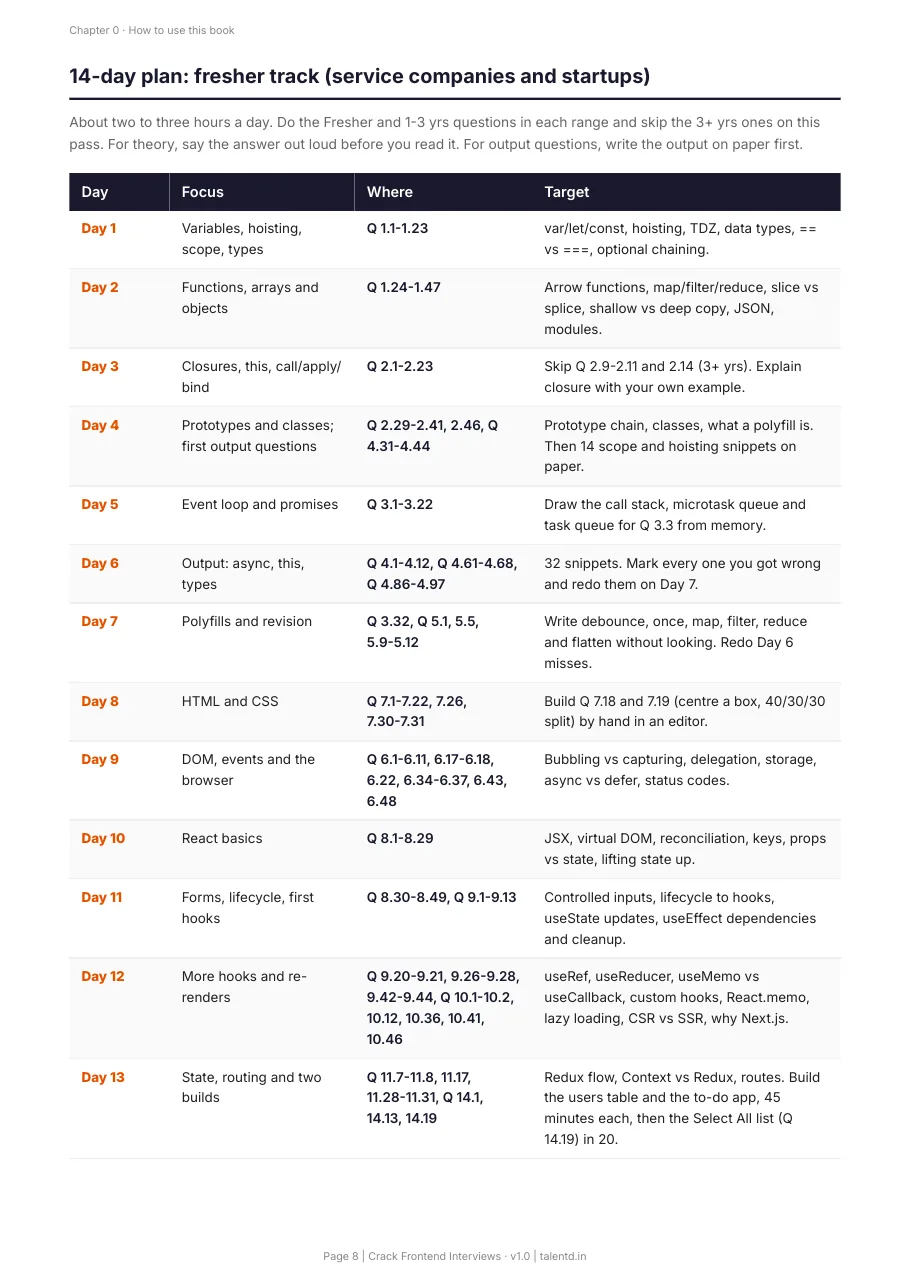
The 14-day fresher plan, day by day
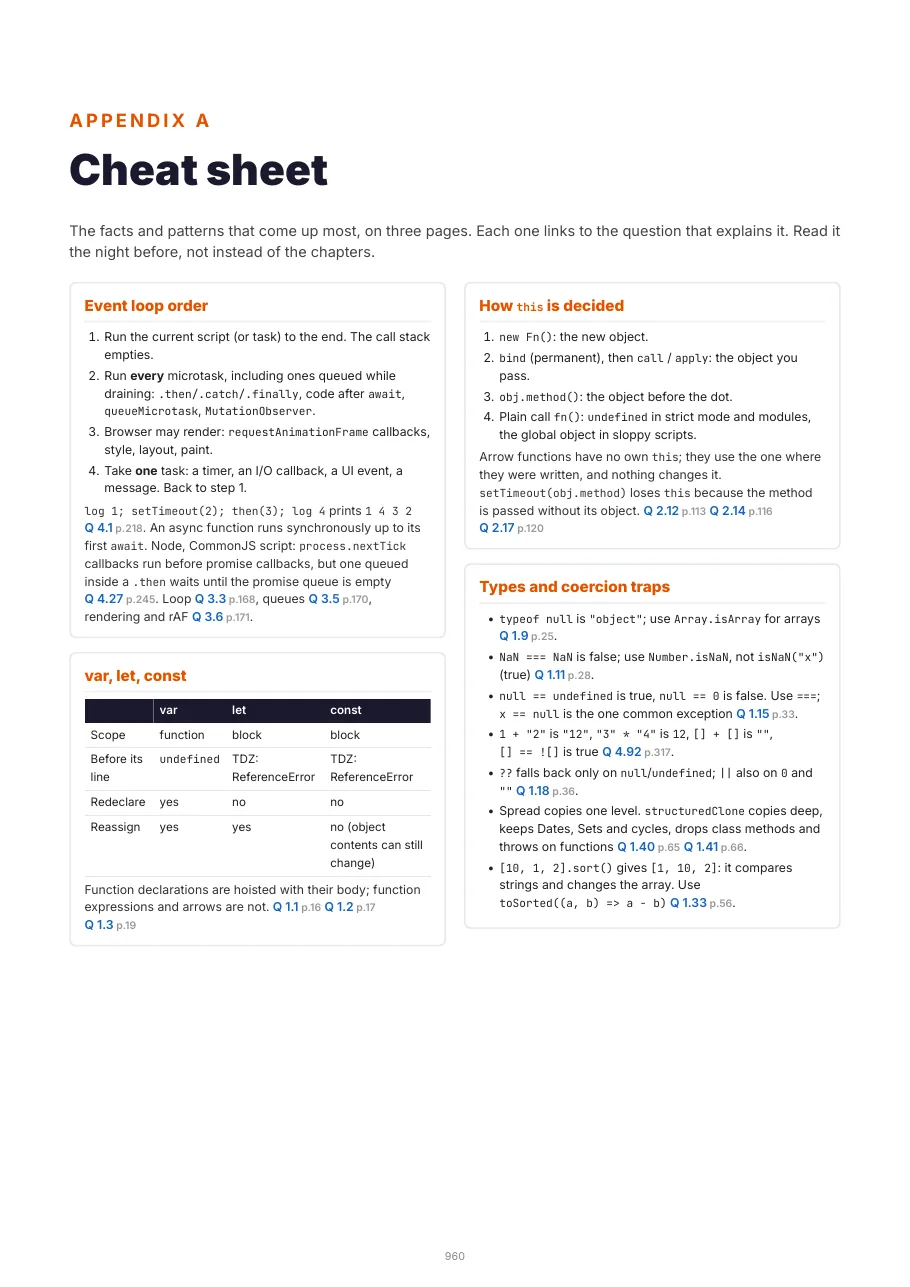
Appendix A: the 3-page cheat sheet
/ How it works
From payment to practice in about a minute
1
Pay in a minute
Name, email and mobile, then UPI, card or net banking on Razorpay. No account needed.
2
Download instantly
Buttons for the book and the three bonus PDFs appear on screen. The same links arrive by email.
3
Start Day 1 today
Pick one of the four study plans in Chapter 0, fresher or product-company track, 14 or 30 days.
/ Why you can trust the answers
Every output was run before it was printed
A question bank is only as good as its answers. This is how this one was checked.
238
outputs printed by Node
238 snippets were run on Node 24.18 and the book shows what they printed. None of the output was typed from memory.
505
answers with a test or run file
Implement answers have node:test files. React answers and the 22 machine-coding builds have Vitest and React Testing Library tests on React 19.3.1. Each answer names its file.
168
interview reports
Company tags come from 168 reports of frontend interviews at companies hiring in India, July 2024 to October 2026. 105 say the interview was in India. No report, no tag.
/ How it compares
What the book adds to free prep
Keep the free stuff. Here's what the book adds.
Swipe to compare →
What you need
BestThis book · ₹299
YouTube playlists
Free question lists
ChatGPT
648 questions in one place
Partial
If you ask
Output from actually running the code
Sometimes
Can be wrong
React 19 and 19.2 APIs covered
Some
Rarely
Can be dated
Machine-coding builds with tests
A few
If you ask
Spoken answer and follow-up, every time
If you ask
14-day and 30-day study plans
If you ask
Works offline, on your phone
/ Bonuses included
Three short PDFs for the last few days
Each entry links to the question in the book that answers it in full.
Bonus 1 · 12 pages
Top 50 JavaScript Questions
The 50 JavaScript questions listed most often across 16 prep sites on Google India's first page, each with a short answer you can say and the book question and page that answers it in full.
Bonus 2 · 12 pages
Top 50 React Questions
The same for React: hooks, rendering, state and what changed in React 18 and 19. Short enough to read the night before the round.
Bonus 3 · 22 pages
Top 100 Frontend Questions
JavaScript, React, the browser and CSS in one list. A question had to appear on at least two of the 16 sites; ties are broken by the 168 interview reports.
Inside the book as well: Appendix A, a 3-page cheat sheet (event loop order, this rules, hooks rules, polyfill patterns, a machine-coding checklist), and Appendix B, a company index with the questions tagged to 102 companies.
/ The kit
Everything above. ₹299 once.
The math
₹299 for 648 questions comes to ₹0.46 a question, with three bonus PDFs and four study plans included. No subscription, nothing to renew.
Bonus 1: Top 50 JavaScript Questions (12-page PDF)
Bonus 2: Top 50 React Questions (12-page PDF)
Bonus 3: Top 100 Frontend Questions (22-page PDF)
Plus
Four study plans: 14 or 30 days, two tracks
3-page cheat sheet and a company index
New versions (1.1, 1.2) free from your order page
30-day refund
₹299
Razorpay secure
Instant PDF
30-day refund
Free updates
One-time payment. Instant download. No recurring charges.
30day refund
/ No risk
Changed your mind before downloading? Get every rupee back.
Email support@talentd.in within 30 days of buying with your order number, before you download any file (the book or a bonus), and we refund the full amount to your original payment method. No forms, no questions. Download access for that order ends with the refund.
/ Honest fit
Who this book is for. And who it isn't.
A good fit if
Your JavaScript or React round is coming up, as a fresher or with up to 5 years of experience
You build things in React at work but freeze on “what does this print?”
You have a machine-coding round and want timed builds to practise
You want one book instead of scattered videos and question lists
Not the right book if
You've never written JavaScript. Learn the basics first, then come back
You need DSA practice. The book covers frontend rounds, not data structures and algorithms
Your interviews are for Angular or Vue. This book is JavaScript and React
You want a promise of the exact questions in your interview. Nobody can honestly make one
/ FAQ
Questions buyers ask
How do I get the book after paying?
Download buttons for the book and the three bonus PDFs appear straight away, and we email you the same links. No account needed.
How does the 30-day refund work?
Email support@talentd.in within 30 days of buying with your order number, before you download any file (the book or a bonus). We refund the full amount to your original payment method; download access for that order ends with the refund.
Which React version does it use?
React 19. Every React answer was tested on React 19.3.1, and the book covers Actions, useActionState, useOptimistic and use, useEffectEvent and <Activity> from React 19.2, and the React Compiler. Older APIs such as class components appear where a codebase may still have them, and the book says so. Routing code uses React Router 8, with the v7 differences noted.
Was every answer really run?
Every output question, every implement answer, every React answer and every machine-coding build has a file that ran it: Node 24.18 for JavaScript, Vitest and React Testing Library on React 19.3.1 for React. The “Checked by” line under each answer names the file. Browser behaviour Node cannot show (layout, paint, real network) and the HTML and CSS snippets are explained, not run.
I have 3 or 4 years of experience. Is it worth it?
126 questions are marked 3+ years: internals, trade-offs and edge cases. Chapters 10, 14 and 15 cover performance, machine coding and frontend system design, and the product-company plans are written for 1 to 5 years of experience.
Does it cover TypeScript and testing?
Yes, as they come up in React interviews: 20 TypeScript for React questions and 15 on testing frontend code with Vitest and React Testing Library.
Can I read it on my phone?
Yes. It's an A4 PDF with clickable contents and question links. It opens on any phone, tablet or laptop; long code blocks are easier on a bigger screen.
What if a library changes after I buy?
The book gets a new version (1.1, 1.2 and so on) when a release changes an answer or a reader finds a mistake. The download link on your order page always gives you the latest version, at no extra cost.
I already bought it. Where are my files?
Open My orders (frontendprep.talentd.in/my-orders) and enter the email you paid with. We email you fresh download links straight away.
Is it a one-time payment?
Yes. Pay once by UPI, card or net banking. No subscription, no auto-renewal.
Can I share my copy?
No. Every page carries your name, email and order number, so a shared copy can be traced to its buyer. We cancel access for that order.
Who wrote the book?
Azhar Khan, founder of Talentd (talentd.in). The questions come from frontend interview reports at companies hiring in India, and every output and test was run on Node 24 and React 19.3 before it was printed.
Your next frontend round is coming. Walk in having seen the questions.
648 questions, three bonus PDFs and four study plans, as one instant download.
 TalentdInterview